Clarendon Broncos state championship victory
The Journey CollectionThe Clarendon Broncos state championship victory is the decisive public triumph of the novel’s football-and-family arc. Played before a community that treats the team as a shared inheritance, the championship moves from apparent defeat to a last-second title and gives Travis McCoy a place in Clarendon that is emotional rather than merely remembered. The Broncos’ victory also becomes the setting in which Max openly calls Travis his father, binding athletic achievement to the formation of a family.
Community, Ritual, and Return
The championship is prepared as a civic ritual long before the decisive play. At the Clarendon homecoming pep rally, Travis hears the band play the fight song and sees students, fans, and parents fill the high-school gymnasium. The crowd’s attention recalls his own years as a player, when he had both hated and loved being watched by the town. The scene establishes football as one of Clarendon’s public languages: the cheerleaders chant “Go, fight, win,” the varsity players wear maroon jerseys with large white numbers, and student-made posters cover the walls in support of the team.
The ceremony fuses local tradition with religious and national forms. The football players enter to the fight song, the cheerleaders lead the Pledge of Allegiance, and the band plays The Star-Spangled Banner before the crowd begins urging the team toward victory against the Gruver Greyhounds. The annual Clarendon-Gruver rivalry reaches back to Travis’s senior year, when students burned a papier-mache figure of a Gruver player during the bonfire. A drought has forced the cancellation of that year’s bonfire, but not the communal spirit surrounding the game. The championship therefore belongs not only to the players on the field but also to a town preserving its identity through repeated ceremony.
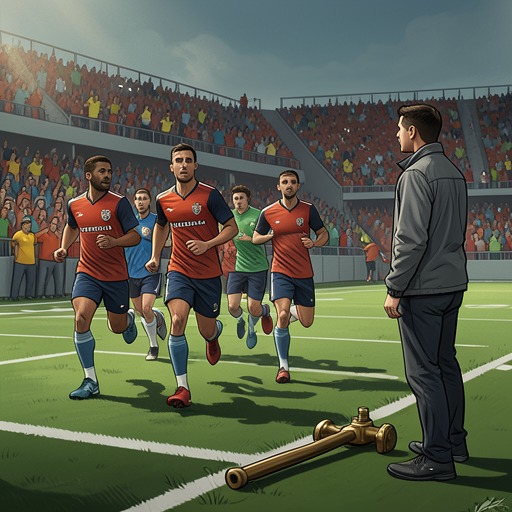
Jack Garrison introduces Travis as a member of the team that reached the state tournament ten years earlier and won the second championship in Clarendon’s history. That introduction turns the returning professional football alumnus into a bridge between generations. Travis initially remains at the edge of the gathering, but he soon moves from remembered champion to active participant. He leads the Broncos through the inflatable tunnel and onto the field, discovering that the moment of homecoming carries more emotional force than the largest stadiums in which he once played.
The Game and the Reversal
The championship begins under pressure. Travis watches the Broncos from seats behind the team and on the fifty-yard line at Darrell K. Royal Texas Memorial Stadium, a privileged position secured through his University of Texas connection. The setting also places Max close to the field, where the boy trembles with excitement and must be pulled back from the barrier to keep him from falling. Travis’s memories of attending his first game there with his grandfather connect his present role as a father to an earlier family inheritance of football.
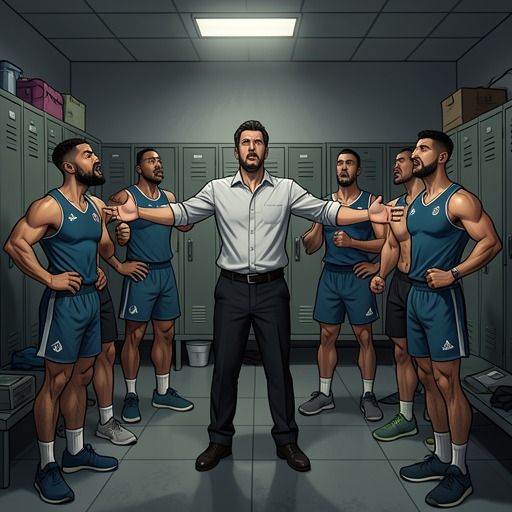
The Broncos lose control of the game in the first half. A mishandled snap flies over Cody’s head and is recovered by the opposing Panthers, and by halftime the Panthers have scored again, extending their advantage to fourteen points. The players retreat to the locker room exhausted and demoralized, turning away when Travis enters. He refuses to let their fear become the meaning of the game and tells them that they can win only if they abandon that attitude. Andy answers that the Panthers are bigger and faster, while Cody identifies the missing quality as “Heart.”
Cody then reframes the stakes. He has spent ten years working to reach the championship and will not throw the opportunity away merely because the opposing team is larger. His standard is not an assured victory but complete commitment: if the Broncos give everything and still lose, they can leave knowing they put it all on the line. Trey and Andy join that recovery of confidence, recalling the team’s earlier comeback against the Bobcats and insisting that the Broncos can impose their own style of play. The halftime exchange changes the game’s value from humiliation to dignity before the scoreboard has changed at all.
The Broncos’ response begins with defense. The Panthers repeatedly attempt to gain a first down, but the Broncos stop them until the Panthers are forced to punt on fourth down. Andy receives the ball, spins away from a defender, and runs down the sideline for a touchdown, then makes the extra point to reduce the deficit to one touchdown. The stadium erupts with Broncos pride. The next kickoff produces another forceful defensive stop, and although the Panthers reach the fifteen-yard line later in the third quarter, the Broncos prevent them from scoring again.
The Final Seconds
The final sequence compresses the entire contest into a struggle for inches and seconds. The Broncos gain a first down and work their way toward the goal line through two more first downs while the clock falls from three minutes to two and then one. With thirty seconds remaining, Cody takes the snap and throws downfield. Andy catches the ball in the end zone, giving the Broncos the touchdown they need to draw level. Travis celebrates by embracing Penelope Stone and spinning her around, but Russ McCoy immediately reminds him that the Broncos still need the extra point to force overtime.
The team chooses risk rather than safety. Travis argues that a championship game is precisely the moment for boldness, and Russ agrees that the decision has arrived. Cody’s attempt begins badly: he stumbles backward after the snap, finds no receiver open, tucks the ball against his chest, and runs to the right. A linebacker blocks his path, so Cody spins left, discovers a gap, and falls across the goal line. The stadium remains silent until the referees raise both arms, signaling that the two-point conversion is good.
The conversion completes the reversal from a fourteen-point deficit to a state title. The crowd’s roar becomes deafening; strangers hug, tears of joy appear, and the Broncos line up along the sideline with their helmets removed. Each player looks toward Travis and nods. Travis returns the gesture with one hand against his chest, acknowledging both the team’s achievement and the community’s recognition of him as one of its own. The victory is not presented as an isolated athletic statistic: it is a collective act of endurance witnessed by the entire town.
Family Consequences
The most intimate consequence of the victory occurs away from the formal celebration. Max climbs onto the bench, wraps his arms around Travis’s neck, and whispers, “Thanks, Dad.” Travis has hoped for that moment but has deliberately avoided forcing it. Max has begun to trust that Travis will not leave or hurt Penelope, yet the deeper requirement is trust that his father loves him. The championship therefore marks a relational victory whose decisive movement is not from losing to winning but from uncertainty to recognition.
The game’s public rituals also prepare later family transitions. Travis proposes to Penelope by declaring that he has loved her since he was fourteen and that she has always owned his heart and soul; she answers yes. Before their marriage, he asks to change Max’s last name legally to McCoy, explaining that if Penelope is going to become a McCoy, he wants Max to be one as well because that is how they can become a real family. During the wedding ceremony, Travis, Penelope, and Max light the eternity candle together, making the child an active participant in the family’s public formation rather than a spectator to the adults’ vows.
The championship’s importance also echoes into the family’s future. Later, Nadine Malone opens a box containing an ultrasound photograph, and Russ reacts with startled emotion when the pregnancy is revealed. Set beside the earlier state-title celebration, this moment extends the novel’s pattern of communal witnessing: football, marriage, legal kinship, and childbirth all become occasions in which private bonds are made visible before family and community.
Narrative and Thematic Significance
The victory turns football from a measure of professional achievement into a language of return. Travis once stood before Clarendon’s watchful crowds as a celebrated player; now he leads younger players onto the field and teaches them that public faith must be answered with effort. His authority comes not simply from having played at a higher level but from understanding fear, pressure, and the cost of abandoning the people who love him.
The game also gives concrete form to the novel’s central contrast between the scoreboard and the heart. At halftime, the Broncos are physically outmatched and fourteen points behind, yet the locker-room speech insists that size and speed do not exhaust the meaning of competition. Their comeback does not erase the difficulty of the first half; it converts that difficulty into evidence of character. The late touchdown and improvised two-point conversion make courage visible as action under diminishing time.
Finally, the championship functions as a rite of reintegration. The pep rally recalls Travis’s past, his entrance onto the field places him among the present team, and the title allows the community to receive him again. The nods from the helmetless players, Max’s “Thanks, Dad,” and the later marriage and shared candle-lighting continue the same movement from separation to belonging. Clarendon’s title is thus both a sports achievement and the public threshold through which Travis, Penelope Stone, and Max begin to live as a family.